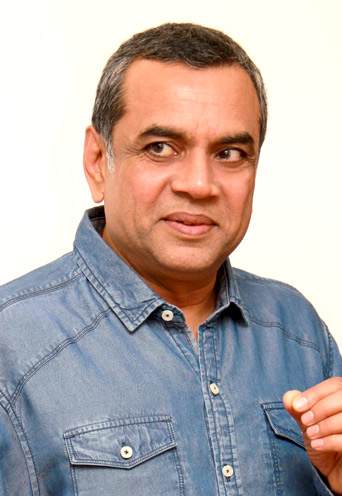
There are two standard routes into serious Indian acting. One is the institution, the National School of Drama or the Film and Television Institute of India, a certificate and a network. The other is a family already in the business. Paresh Rawal had neither. He took a commerce degree at Narsee Monjee, did Gujarati plays alongside it, and then spent fifteen years being the man the hero eventually beats up, in over a hundred films across the late eighties and nineties. The industry filed him under villain and left him there. He got out of that drawer twice, once in 1993 when a national jury gave him a single award for two performances, and again in 2000 when a Marathi landlord in a Priyadarshan comedy rewired his entire market at forty five. The stage never stopped running underneath any of it, which is the fact this page is built on.
The arc
01No certificate, one stage
He was born and raised in Bombay in a Gujarati family, finished his education in the city and graduated from Narsee Monjee College of Commerce and Economics in Vile Parle. During those college years he was doing theatre, and that theatre came before films rather than alongside them. That sequence is the whole thing. There is no acting school, no film institute, no father in the industry.
In 1987 he married Swaroop Sampat, the 1979 Miss India winner and an actress in her own right, and they have two sons. The elder, Aditya, debuted as an actor and writer with Bamfaad in 2020. Everything the family knows about performance, it learned in a rehearsal room rather than a classroom.
02A hundred films of being disliked
Arjun in 1985 was the debut and Naam in 1986 was the film that established him, and then came the long stretch that most accounts of his career skip past in a sentence. More than a hundred films through the late eighties and nineties, mostly as the antagonist: Ram Lakhan, Kabzaa, King Uncle, Roop Ki Rani Choron Ka Raja, Dilwale, Daud, Baazi, Mohra, China Gate.
He was doing the same job in Telugu at the same time, and doing it well enough that the hits stack up on their own: Kshana Kshanam in 1991, Govinda Govinda in 1994, Money Money in 1995, Rikshavodu in 1995, Bavagaru Bagunnara in 1998. Two industries, one register, no shortage of work and no critical attention whatsoever. That is the situation a character actor normally retires from.
03One award, two films
At the 41st National Film Awards, honouring films of 1993, he won Best Supporting Actor and the award was given for two films at once, Woh Chokri and Sir. The official citation reads, for his performances in the films to reveal contradictory human emotions at the outer and inner levels. That is a jury explicitly rewarding the double act rather than a single performance, which is unusual enough to be worth stating plainly.
The same year, Sir brought him his first Filmfare Award, for Best Performance in a Negative Role, which is Hindi cinema's polite way of saying we noticed the villain. Then came Ketan Mehta's Sardar in 1993, in which he played Vallabhbhai Patel in the lead, and the recognition finally went past the industry. It is worth noticing which prize came from where. The film industry gave him an award for being frightening. The national jury gave him one for being complicated.
04Baburao changes the market
Hera Pheri opened in 2000, directed by Priyadarshan, screenplay adapted by the Bhuj-born Gujarati writer Neeraj Vora, and he played Baburao Ganpatrao Apte, a Marathi landlord with a pair of tenants and a wrong number. He won the Filmfare Best Comedian Award for it, and for the rest of the decade the offers came for leads rather than for menace: Nayak, Aankhen with Amitabh Bachchan, Awara Paagal Deewana, Hungama, Hulchul, Garam Masala, Malamaal Weekly, Chup Chup Ke, Welcome, Oye Lucky! Lucky Oye!, De Dana Dan, Ready.
OMG in 2012 gave him the lead in a film arguing with religion, and the run since then has been steady rather than nostalgic: Sanju in 2018 as Sunil Dutt, Uri in 2019, Soorarai Pottru in Tamil in 2020 and the same role again in the Hindi version Sarfira in 2024, and The Storyteller in 2025 as Satyajit Ray's Tarini Khuro. A Gujarati stage actor playing a Bengali writer's most beloved character is the kind of range that stops being remarkable only because he does it so often.
05Dear Father, and the school
The Gujarati thread is not a nostalgia clause on this career. His Gujarati play Dear Father was successful on stage and was then adapted into a Gujarati film of the same name, directed by Umang Vyas and released on 4 March 2022, with him leading opposite Manasi Parekh and Chetan Dhanani. He has said in interviews that the timing finally felt right to return to Gujarati cinema after decades away. Very few actors of his size have a film on their record that exists because of a play they did for a regional audience.
Then on 10 September 2020 the President of India appointed him chief of the National School of Drama. Read that against the first act of this page. The institution he never attended, and never needed, handed him the keys. It is the cleanest available argument that a working stage in Bombay taught him everything a training programme would have, and it also happens to be the argument every Gujarati theatre actor on this site has been making for a century.
The work that matters
The film that got him both prizes at once and from opposite directions. Half a National Award from the national jury and his first Filmfare, awarded for a negative role. Two juries looking at the same performance and disagreeing about what it was.
Not the obvious pick from that year. Ketan Mehta gave a working villain the lead as Vallabhbhai Patel, written by Vijay Tendulkar, and the film is why his name travelled outside the industry it had been stuck in.
The only film on a 240-title record that exists because of a Gujarati play he chose to do. Directed by Umang Vyas, opposite Manasi Parekh and Chetan Dhanani. It is the receipt for the stage career, not a lap of honour.
Verified credits
| Year | Work | Language | Why it is here |
|---|---|---|---|
| 1985 | Arjun | Hindi | Screen debut, supporting part |
| 1986 | Naam | Hindi | The film that established him |
| 1991 | Kshana Kshanam | Telugu | Start of a parallel run as a Telugu antagonist |
| 1993 | Sir | Hindi | First Filmfare, for a negative role, and half a National Award |
| 1993 | Woh Chokri | Hindi | The other half of the same National Award |
| 1993 | Sardar | Hindi | Lead role as Vallabhbhai Patel, for Ketan Mehta |
| 2000 | Hera Pheri | Hindi | Baburao Ganpatrao Apte, and the Filmfare Best Comedian Award |
| 2012 | OMG | Hindi | Lead in a film built entirely on his argument |
| 2018 | Sanju | Hindi | Played Sunil Dutt for Rajkumar Hirani |
| 2020 | Soorarai Pottru | Tamil | The role he then played again in the 2024 Hindi version, Sarfira |
| 2022 | Dear Father | Gujarati | His own Gujarati play, adapted for the screen |
| 2025 | The Storyteller | Hindi | Played Satyajit Ray's Tarini Khuro |
Questions people ask
How many National Awards has Paresh Rawal won?
One. He won Best Supporting Actor at the 41st National Film Awards, for films of 1993, and the award covered two films at once, Sir and Woh Chokri. The official citation credits him for revealing contradictory human emotions at the outer and inner levels. He also holds three Filmfare Awards and received the Padma Shri in 2014.
Did Paresh Rawal start in Gujarati theatre?
Yes. He was involved in theatre during his college years at Narsee Monjee College of Commerce and Economics, and that stage work preceded his entry into films. He has kept performing in Gujarati plays throughout his film career, the best known of them being Dear Father.
Is Dear Father based on a play?
Yes, his own. Dear Father began as a Gujarati stage play he performed in, and it was adapted into a Gujarati film of the same name directed by Umang Vyas, released on 4 March 2022, with Rawal in the lead alongside Manasi Parekh and Chetan Dhanani.
Is Paresh Rawal the head of the National School of Drama?
He was appointed chief of the National School of Drama by the President of India on 10 September 2020. He has no formal drama school training himself, having graduated in commerce and learned the craft in Gujarati theatre in Bombay.
Was Paresh Rawal a Member of Parliament?
Yes. He won the Ahmedabad East constituency as a Bharatiya Janata Party candidate in the 2014 Indian general election. He received the Padma Shri the same year.
Sources
All dates, credits and award cycles were checked against English Wikipedia and the National Film Awards record in July 2026. The award citation quoted is the official published wording. One discrepancy is worth flagging: Gujarati Wikipedia gives his birth year as 1950 while English Wikipedia gives 30 May 1955, and this page follows the English record. No quote here is invented.
- English Wikipedia biography of Paresh Rawal, retrieved July 2026
- English Wikipedia list of awards and nominations received by Paresh Rawal
- 41st National Film Awards page, for the Best Supporting Actor citation and the two films it covered
- English Wikipedia pages for Sir (1993 film), Woh Chokri, Sardar (1993 film), Hera Pheri (2000 film) and Dear Father (2022 film)
- Gujarati Wikipedia entry on Paresh Rawal, used as a second source on the Gujarati stage career
- Wikimedia Commons file page for the photograph, for the photographer, date and licence