Krishnadev Yagnik has more produced Gujarati screenplays than anyone else working today, with nine named feature credits including Chhello Divas, Shu Thayu? and Vash, which won Best Gujarati Feature Film at the 71st National Film Awards. Raam Mori follows with five, and he is the only Sahitya Akademi Yuva Puraskar winner in the group. Niren Bhatt started in Gujarati with Bey Yaar and Wrong Side Raju and went on to write Stree 2, one of the highest grossing Hindi films of all time.
Gujarati cinema gets talked about through its actors and its directors. The writers stay invisible, which is strange, because the revival that started with Kevi Rite Jaish in 2012 was not a casting revolution or a camera revolution. It was a script revolution. Someone finally wrote college boys who spoke the way college boys in Ahmedabad actually speak. Someone wrote a widow in the Rann of Kutch who dances because nothing else is left. Every hit of the last decade traces back to a page before it traces back to a face.
This list ranks the 20 screenwriters who put those pages on screen, ordered by produced Gujarati feature credits that can be traced to a named film in an IMDb-sourced credits database. Nobody is here on reputation. A writer with one credit and a National Award outranks a writer with four credits and no proof, and a writer with neither is not on the page at all. Twelve of these twenty have written or co-written a film that won something at the National Film Awards, which for an industry that released fewer than ten films a year in 2011 is a striking hit rate.
The list at a glance
| Screenwriter | Named Gujarati credits | Signature script | Hardest credential |
|---|---|---|---|
| Krishnadev Yagnik | 9 | Chhello Divas (2015) | Vash won Best Gujarati Feature Film at the 71st National Film Awards |
| Raam Mori | 5 | 21mu Tiffin (2021) | Sahitya Akademi Yuva Puraskar 2017 for the story collection Mahotu |
| Niren Bhatt | 3 | Bey Yaar (2014) | Wrote Stree 2, one of the highest grossing Hindi films of all time |
| Ishaan Randeria | 3 | Gujjubhai the Great (2015) | Turned a stage franchise into a three film screen franchise |
| Rahul Bhole | 3 | Reva (2018) | Reva won Best Feature Film in Gujarati at the 66th National Film Awards |
| Vipul Mehta | 3 | Chaal Jeevi Laiye! (2019) | Reported gross above Rs 50 crore and a 50 week theatrical run |
| Vipul Sharma | 3 | Shubh Mangal Dhamal (2026) | Directed Ratanpur, and writes and directs only in Gujarati |
| Jay Bodas | 2 | Fakt Purusho Maate (2024) | Directed Fakt Mahilao Maate, which brought Amitabh Bachchan to Gujarati cinema |
| Faisal Hashmi | 2 | Short Circuit (2019) | Wrote the first Gujarati science fiction feature |
| Chetan Dhanani | 2 | Reva (2018) | Co-wrote a National Award winning film and acted in Kasoombo |
| Karan Vyas | 2 | Ventilator (2018) | Co-wrote Wrong Side Raju and the Scam 1992 screenplay |
| Karan Bhanushali | 2 | Fakt Mahilao Maate (2022) | Kutch Express took three prizes at the 70th National Film Awards |
| Dhwani Gautam | 2 | Romance Complicated (2016) | Wrote and directed his own debut at 31 |
| Abhishek Shah | 1 | Hellaro (2019) | Hellaro won the National Film Award for Best Feature Film |
| Pan Nalin | 1 | Chhello Show (2021) | India's entry for Best International Feature at the 95th Academy Awards |
| Mikhil Musale | 1 | Wrong Side Raju (2016) | Best Feature Film in Gujarati at the 64th National Film Awards |
| Hardik Mehta | 1 | Amdavad Ma Famous (2015) | Best Non-Feature Film at the 63rd National Film Awards |
| Ankit Sakhiya | 1 | Laalo: Krishna Sada Sahaayate (2025) | Reported gross of about Rs 120 crore on a Rs 50 lakh budget |
| Saumya Joshi | 1 | Hellaro dialogues and lyrics | Chandravadan Chimanlal Mehta Award, 2013 |
How this list was built
Every writing credit here is traced to a named film in an IMDb-sourced Gujarati credits database covering 118 films from 2014 to 2026, then cross checked against English Wikipedia film articles and the National Film Awards ceremony records. Ranking is by the number of Gujarati feature writing credits that can actually be enumerated, with award-winning work breaking ties. Where the database's headline tally and its own enumerated titles disagreed, the enumerated titles won, which is why Krishnadev Yagnik sits at nine rather than ten. Several writers were researched and then cut. Bhavesh Mandalia, who co-wrote Bey Yaar with Niren Bhatt and co-wrote the Hindi film OMG: Oh My God, has no free-licensed photograph and no personal Instagram account that a scrape could confirm, so he was dropped rather than shipped with a guess. Gireesh Parmar, Paresh Vyas, Nirav Barot and Jay Bhatt were dropped for the same reason. Umang Vyas was dropped because the credits database names him as writer of Jhamkudi while the film's Wikipedia article credits Heath Bhatt, and a disputed credit is worse than a missing one. Prateek Gupta is missing from this page and should not be: the earlier note here said the film record placed him among Hellaro's producers rather than its writers, and a recheck on 30 July 2026 found the film's own article names him on the screenplay alongside Abhishek Shah, as well as editing and co-producing it. His credit is real, the omission is a gap in this list rather than a disputed attribution, and it is carried forward for the next pass. Nishith Brahmbhatt, Vinit Kanojia and Parth Trivedi were dropped because no account could be scrape-confirmed as theirs. One credit was deliberately left out of Niren Bhatt's entry: his Wikipedia biography implies he broke through with Bala, but the Bala article credits an original story by Pavel Bhattacharjee and names no screenwriter, so the credit is omitted here. Manish Saini, director of the National Award winning Dhh, was removed from this list on 29 July 2026: the only Instagram account carrying his name has an empty biography and no verifiable link to his films, and no free-licensed photograph of him exists. A name match is not a verification. Two credits were corrected against the film record on 30 July 2026, after this page first published. Nayika Devi: The Warrior Queen was removed from Raam Mori's list because that film credits Umesh Sharma as its writer and Mori's own filmography does not include it; Mara Pappa Superhero, which names Mori as writer on the film's own record, was added in its place, so his total is unchanged at five. Vipul Sharma dropped from four credits to three: the film record credits him as director of Ratanpur and gives the screenplay to Shailesh Dodia, and the database-only attributions on Deshbook and Shubh Aarambh are now marked unconfirmed, while Order Order Out of Order stands because the film's own article names him among its writers.
The volume writers
Five names account for a quarter of every traceable Gujarati writing credit since 2014.
1Krishnadev Yagnik
Yagnik wrote and directed Chhello Divas in 2015, a college comedy about eight friends in their final year that was remade in Hindi the next year as Days of Tafree with Yagnik himself directing. He co-founded Belvedere Films, and the credits since then read like a stress test of range: Karsandas Pay & Use in 2017, Shu Thayu? in 2018, Vandha Villas the same year for director Chinmay Parmar, then Raado and Naadi Dosh in 2022, Vash in 2023, Danny Jigar in 2024 with Jaswant Parmar, and Vash Level 2 in 2025. Vash won Best Gujarati Feature Film at the 71st National Film Awards and took Janki Bodiwala the Best Supporting Actress prize alongside it.
What makes him the most important writer in the industry is not the comedy, it is that he proved the same pen could build a horror franchise. Vash Level 2 released on 27 August 2025 with a Hindi dubbed version, set twelve years after the first film, which is franchise architecture nobody attempted in Gujarati before him. Most regional writers get one register and stay in it. Yagnik wrote the definitive Gujarati campus comedy and then wrote the definitive Gujarati possession horror, and both of them made money. That is two industries built by one person.
Instagram: @krishnadevyagnik (verified 2026-07-29).
2Raam Mori

Mori came to film from the page, not the set. His debut short story collection Mahotu won the Sahitya Akademi's Yuva Puraskar in 2017, and his fiction is known for rural Saurashtra and for putting women at the centre of it. His screen credits carry the same signature: Montu Ni Bittu in 2019 with Prarthi Dholakia, 21mu Tiffin in 2021 adapted from his own short story about a woman running a tiffin service, Mara Pappa Superhero the same year for director Darshan Ashwin Trivedi, Kasoombo in 2024 with Vijaygiri Bava, and Maharani in 2025 with Hardik Sangani. He also wrote the dialogues for Kutch Express in 2023, which is a credit on the print rather than a screenplay of his own.
Five produced features makes him the second most credited writer in Gujarati cinema, but the number undersells him. 21mu Tiffin and Maharani are both led by a woman who is not anyone's love interest, in an industry whose commercial spine is the male friendship comedy. When a director wants a Gujarati story that will hold in a festival programme and still fill a Rajkot single screen, Mori is the phone call. He is the closest thing the industry has to a literary house writer. One title that is often attached to him is missing above on purpose: Nayika Devi: The Warrior Queen credits Umesh Sharma as its writer and Mori's own filmography does not list it, so it is not counted here.
Photo: Farhad Shaikh, CC BY-SA 4.0, via Wikimedia Commons.
3Niren Bhatt
Bhatt holds a Master's in Engineering and Business Administration and worked as a business consultant until 2011, when he quit to write full time. He wrote commercials and Gujarati plays first, then broke through on the long running sitcom Taarak Mehta Ka Ooltah Chashmah. His Gujarati features are three, and all three matter: the script and lyrics for Bey Yaar in 2014 with Bhavesh Mandalia, which ran fifty weeks and became the first post-revival blockbuster, then Wrong Side Raju in 2016 with Mikhil Musale and Karan Vyas, then Ventilator in 2018 with Karan Vyas.
Then he left and became one of the biggest writers in Hindi cinema, which is worth stating precisely because the internet tends to inflate it. He wrote Made in China in 2019 for Mikhil Musale, adapted the novel Serious Men for Netflix in 2020, wrote the story and screenplay for Bhediya in 2022, wrote Munjya in 2024 and wrote Stree 2 in 2024, which became one of the highest grossing Hindi films of all time. He is credited as co-creator of the Maddock Supernatural Universe with Amar Kaushik. On the streaming side he wrote for Inside Edge, Asur and two episodes of Ray, one of them in Urdu. He has been nominated for Best Dialogue at the 65th Filmfare Awards and Best Story at the 68th. Three Gujarati scripts were his entire runway, and he used them to take off.
Instagram: @nirenbhatt (verified 2026-07-29).
4Ishaan Randeria
Randeria wrote and directed Gujjubhai the Great in 2015, adapting the long running Gujjubhai stage play franchise starring Siddharth Randeria for the screen. He followed it with GujjuBhai Most Wanted in 2018 and Bushirt T-shirt in 2023 for Coconut Motion Pictures, and he also produced Hu ane Tu in 2023. Three written features, all comedies, all released, all profitable enough to justify the next one.
Adapting theatre to film is the hardest translation job in the business, because stage comedy runs on the audience laughing in the room and screen comedy has to work in silence. Randeria's fix was to keep the Gujjubhai character intact and rebuild everything around him for a camera. The result is the only true multi-film comedy franchise Gujarati cinema has, and it exists because someone was willing to write the same character three times without letting him go stale.
Instagram: @randeriaishaan (verified 2026-07-29).
5Vipul Sharma
Sharma is here for a run of films he both writes and directs, and his entry needs one correction stated plainly rather than buried. He shares the writing credit on Order Order Out of Order in 2019 with Dhwani Gautam and Shyam Khandhedia, which the film's own record confirms, and he is the credited writer-director of Frendo in 2024 and Shubh Mangal Dhamal in 2026, both carried by the credit blocks those productions published. Ratanpur in 2018, a thriller built around an IPS officer newly posted to a village, is his as director, not as writer: the film credits its screenplay to Shailesh Dodia. Deshbook in 2014 and Shubh Aarambh in 2017 are attached to him by a credits database with no second source behind either, so they sit here as unconfirmed rather than as credits.
What is left is a working writer-director who never took the exit. His account documents a steady release cadence, Bicharo Bachelor in January 2026, Shubh Mangal Dhamal in May 2026 and Shreeman Sandwich announced for January 2027, with the same lead actor and much of the same crew turning up film after film. That is the unglamorous version of a screenwriting career: no National Award shelf, no crossover to Mumbai, just a decade of getting films finished and released in a market where most scripts die in a producer's drawer.
Instagram: @vipulsharmadirector (verified 2026-07-29).
The National Award shelf
Eight writers whose scripts have a jury citation attached to them.
6Abhishek Shah
Hellaro was Shah's directorial debut and he co-wrote it. Set among a group of women in the Rann of Kutch in the 1970s, it won the National Film Award for Best Feature Film at the 66th National Film Awards, the top prize in Indian cinema that year, and it opened the Indian Panorama at the 50th International Film Festival of India. No Gujarati film had ever taken the Swarna Kamal. Shah produced it too, under Harfanmaula Films with Saarthi Productions.
The script's engine is restraint. A group of village women find a drummer in the desert and start dancing garba where nobody can see them, and the film lets that single act carry the entire weight of what the women are not allowed to do anywhere else. Shah has since directed Umbarro, written by Hemant Dhome. One writing credit on this list, and it is the one that changed what a Gujarati script was allowed to be about.
Instagram: @abhishek_humanbeing (verified 2026-07-29).
7Pan Nalin

Nalin wrote and directed Chhello Show, a semi-autobiographical film about a boy in rural Gujarat who falls in love with projected light. It premiered at the 20th Tribeca Film Festival on 10 June 2021 and released in Indian cinemas on 14 October 2022. India selected it as the country's entry for Best International Feature Film at the 95th Academy Awards, and it made the Academy's shortlist. Before it he had directed Samsara in 2001, which won Best First Feature Film at the Durban International Film Festival and a special jury mention at AFI Fest, then Valley of Flowers in 2006 and Angry Indian Goddesses in 2015.
He is the outlier here in every way that counts. His films are co-produced across India, France, Germany, Italy, Japan and the United States, and he had a two decade international career before he wrote anything in Gujarati. Then he came home and wrote the most personal script of his life in his own language, and that is the one the country sent to the Oscars. Sometimes the long way round is the shortest route to the thing you were always going to write.
Photo: Benny Crude, CC BY-SA 4.0, via Wikimedia Commons.
8Mikhil Musale
Musale founded CineMan Productions in 2010 with Abhishek Jain and Anish Shah, six years before he directed anything. Wrong Side Raju in 2016 was his first film as director and he co-wrote it with Niren Bhatt and Karan Vyas. The story was drawn from a 2013 hit and run case in Ahmedabad, and it won the National Film Award for Best Feature Film in Gujarati at the 64th National Film Awards. It also gave Pratik Gandhi the lead role that preceded Scam 1992.
Taking a real hit and run and turning it into a commercial thriller is a script problem before it is a directing problem, because the audience already knows the ending from the newspapers. The fix was to make the film about the machinery around the crime rather than the crime. Musale moved to Hindi after that with Made in China in 2019 and later Sajni Shinde Ka Viral Video for Netflix, but the Gujarati credit is the one with a National Award on it.
Instagram: @mikhilmusale88 (verified 2026-07-29).
9Karan Vyas
Vyas co-wrote Wrong Side Raju with Mikhil Musale and Niren Bhatt, then co-wrote the Gujarati Ventilator with Bhatt in 2018, an adaptation of Rajesh Mapuskar's Marathi original for director Umang Vyas. Two Gujarati features, both of them ensemble pieces with a dozen speaking parts to keep alive at once, which is the hardest structural exercise in commercial writing.
He then joined the writing team on Scam 1992: The Harshad Mehta Story, sharing screenplay and dialogue credit with Sumit Purohit, Saurabh Dey and Vaibhav Vishal on what became one of the most watched Indian series ever made. His own account lists Scam 2003, Scoop and Raid 2 after it. The Gujarati industry keeps producing writers who are good enough to leave, which is a compliment to its training and a problem for its future.
Instagram: @karanvyas11 (verified 2026-07-29).
10Rahul Bhole
Bhole directed and co-wrote Chor Bani Thangaat Kare in 2017 with Chetan Dhanani, Mehul Vyas and Vinit Kanojia. He then co-directed Reva in 2018 with Kanojia and co-wrote it with Dhanani and Kanojia, and Reva won the National Film Award for Best Feature Film in Gujarati at the 66th National Film Awards, the same ceremony where Hellaro took the top national prize. He co-wrote and co-directed Vickida No Varghodo in 2022 with Kanojia, and co-directed All The Best Pandya in 2025.
The Bhole and Kanojia partnership is the most consistent writing room in Gujarati cinema and almost nobody outside the industry can name it. They write together, direct together and have done it across a comedy, a spiritual drama and a wedding farce without the seams showing. Bhole also writes a science column, which is a genuinely useful thing for a screenwriter to do: it forces you to explain complicated things to a stranger in eight hundred words, every week, forever.
Instagram: @rahul_bhole11 (verified 2026-07-29).
11Chetan Dhanani
Dhanani co-wrote Chor Bani Thangaat Kare in 2017 and Reva in 2018 with Rahul Bhole and Vinit Kanojia, which means his name is on the film that won Best Feature Film in Gujarati at the 66th National Film Awards. He also acts, and acts a lot: he appears in Kasoombo alongside Raunaq Kamdar and Dharmendra Gohil, and his listed credits run through Okhamandal and Shastra. He writes lyrics as well, and came up through Gujarati theatre before any of it.
The writer who also performs has an unfair advantage, and it is not the one people assume. It is not that he writes better dialogue. It is that he has stood on a stage and felt a line die, which teaches you in about two seconds what a year of notes cannot. Dhanani's scripts have very few lines that exist to sound clever. That is a habit you learn from the other side of the page.
Instagram: @thatschetan (verified 2026-07-29).
12Hardik Mehta
Mehta directed Amdavad Ma Famous, a documentary about the kite flying festival in Ahmedabad shot with cinematographers Piyush Puty and Harshbir Singh and produced by Akanksha Tewari and Arya A. Menon. It won the National Film Award for Best Non-Feature Film at the 63rd National Film Awards for 2015, and he appeared as one of the Indian Panorama directors at the 47th International Film Festival of India in Goa in 2016. He works in both fiction and non-fiction, which on this list is rare.
His screenwriting credits since then sit almost entirely in Hindi: Trapped, Kaamyaab, the first season of Paatal Lok, plus Roohi, Decoupled and Love Storiyaan. Amdavad Ma Famous is forty minutes long and it is still the sharpest thing anyone has written about Gujarati obsession, which is a category that includes business, cricket and marriage. A boy wants to catch a kite. That is the whole story and it is enough.
Instagram: @serialclicker811 (verified 2026-07-29).
The box office engine
Five writers whose scripts pay for everybody else's festival films.
13Jay Bodas
Bodas directed Fakt Mahilao Maate in 2022, written by Karan Bhanushali, which put Amitabh Bachchan in a Gujarati film in a special appearance for the first time. He then co-wrote and co-directed Fakt Purusho Maate in 2024 with Parth Trivedi, and co-wrote Chaniya Toli in 2025 with Pratiksinh Chavda for a Diwali release, both produced by Anand Pandit Motion Pictures with Vaishal Shah.
The Fakt films are built on a premise so simple it looks like a marketing brief: one film about what women say when men are not around, one about the reverse. That kind of high concept only works if the writing is disciplined enough to keep the joke from becoming the entire film, and Bodas has now done it twice with different co-writers. He is the writer producers call when they need a title that sells a ticket before anyone has read a review.
Instagram: @jaybodas (verified 2026-07-29).
14Vipul Mehta
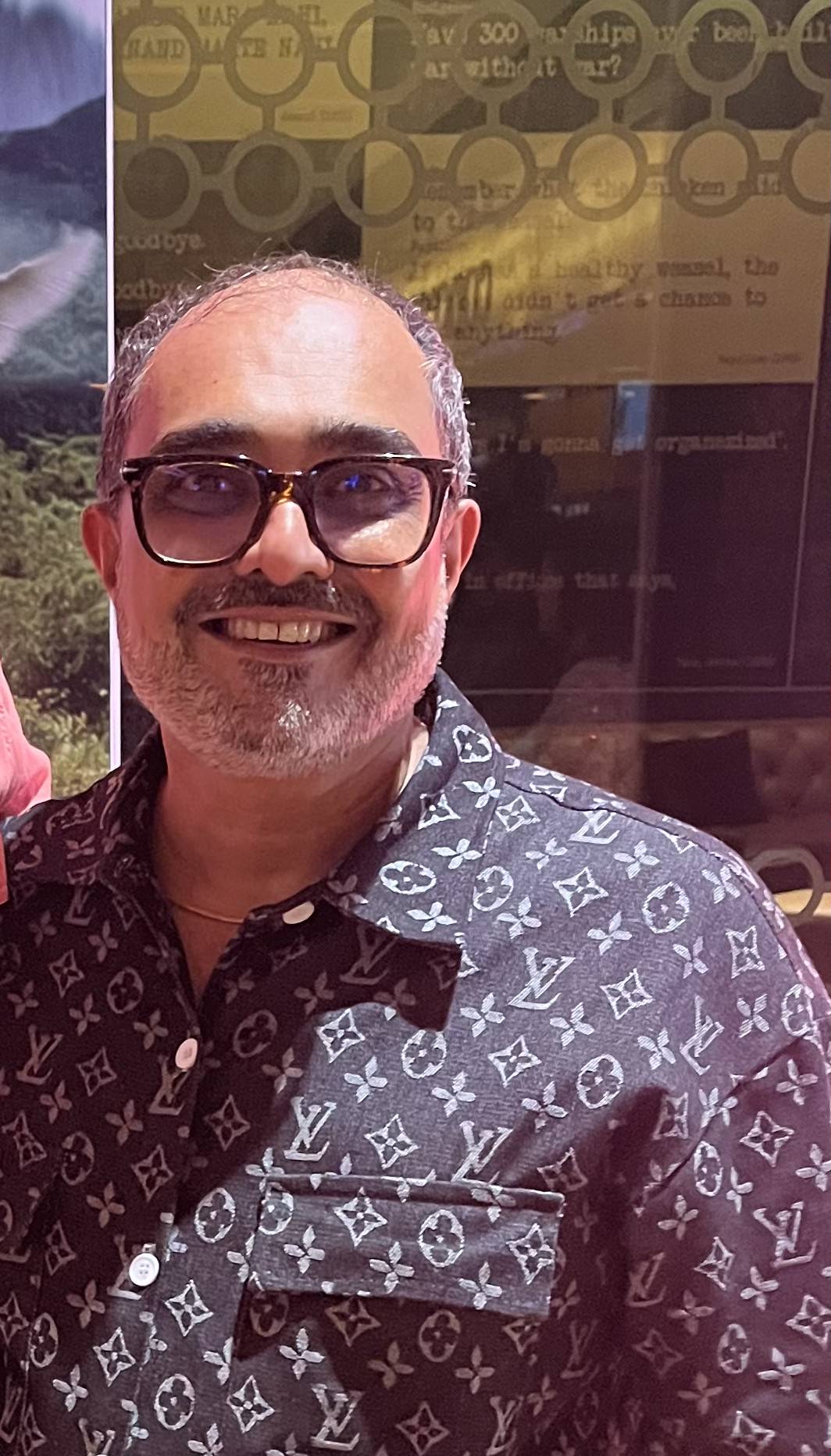
Mehta wrote and directed Chaal Jeevi Laiye! in 2019 with Jainish Ejardar, a father and son road film starring Siddharth Randeria, Yash Soni and Aarohi Patel. Its reported gross went past Rs 50 crore, it entered its eighth year in cinemas on 1 February 2026, and it held the Gujarati box office record for six years. He also wrote Carry On Kesar in 2017 with Ankit Trivedi and Bhumika Trivedi, wrote and directed Kehvatlal Parivar in 2022, and directed Bachu Ni Benpani in 2025, all for Coconut Motion Pictures.
The proof that the script and not the star was doing the work came in 2024, when Mehta remade Chaal Jeevi Laiye! in Marathi as Ole Aale with Nana Patekar. He wrote and directed that version too, and it collected eight nominations at the Filmfare Awards Marathi 2025. Same story, different language, different cast, same result. A structure that survives a full transplant is not a lucky film. It is a well built one.
Photo: Editorharpsweetrolls, CC BY-SA 4.0, via Wikimedia Commons.
15Karan Bhanushali
Bhanushali wrote Fakt Mahilao Maate for director Jay Bodas in 2022, the film that brought Amitabh Bachchan into Gujarati cinema, then co-wrote Kutch Express in 2023 with Rahul Mallick and Viraf Patel for director Viral Shah. Kutch Express won three prizes at the 70th National Film Awards: Best Film on Social and Environmental Values, Best Actress for Manasi Parekh, and Best Costume Design for Niki Joshi. His own listed credits include Chal Man Jeetva Jaiye, Umbarro, and long stretches on the Hindi television shows Wagle Ki Duniya, Kahaan Hum Kahaan Tum and Taarak Mehta Ka Ooltah Chashmah.
Daily television is the most brutal writing gym in India, because the deadline never moves and the audience notices everything. Bhanushali came out of it able to write a broad crowd comedy and a jury-pleasing social drama within twelve months of each other. Those two films sit at opposite ends of the industry, and the same person built both of them.
Instagram: @karandirect (verified 2026-07-29).
16Ankit Sakhiya
Sakhiya directed Laalo: Krishna Sada Sahaayate in 2025 and co-wrote it with Krushansh Vaja and Vicky Poornima. A devotional drama starring Reeva Rachh and Shruhad Goswami, made for a reported budget of about Rs 50 lakh, it went on to a reported worldwide gross of roughly Rs 120 crore, the highest figure ever reported for a Gujarati film. Those numbers are industry-reported and not audited, which is true of every box office number in this industry.
Every list of Gujarati cinema's commercial ceiling had to be rewritten after Laalo, and the interesting part is what it says about the audience. The industry had spent a decade convinced that urban comedy was the only reliable product. Sakhiya wrote a faith film aimed squarely at a viewer that Ahmedabad multiplex marketing had quietly written off, and that viewer turned up in numbers nobody had modelled. One credit on this list, and it moved the ceiling by a factor of two.
Instagram: @ankitsakhiyaofficial (verified 2026-07-29).
17Faisal Hashmi

Hashmi grew up in Palanpur, took a mechanical engineering degree and did not use it. He directed and co-wrote Vitamin She with Mohsin Chavada in 2017, a romantic comedy released on 28 July that year which ran six weeks houseful. He followed it with Short Circuit in 2019, co-written with Bhargav Purohit and Mohsin Chavada, built on a time loop premise and billed as the first Gujarati science fiction feature. It collected eleven nominations at the Gujarati Iconic Film Awards, including Best Story and Best Screenplay.
Writing science fiction in a regional language with a small budget is a structural dare, because you cannot spend your way out of a plot hole with visual effects. A time loop especially punishes lazy writing, since the audience gets to watch the same scene repeatedly and will catch every cheat. That Short Circuit came out of an industry that had been making almost nothing but friendship comedies for five years is the most underrated thing on this page.
Photo: Criusblack, CC BY-SA 4.0, via Wikimedia Commons.
From the stage and the page
Two writers who arrived in cinema with a body of work already behind them.
18Saumya Joshi
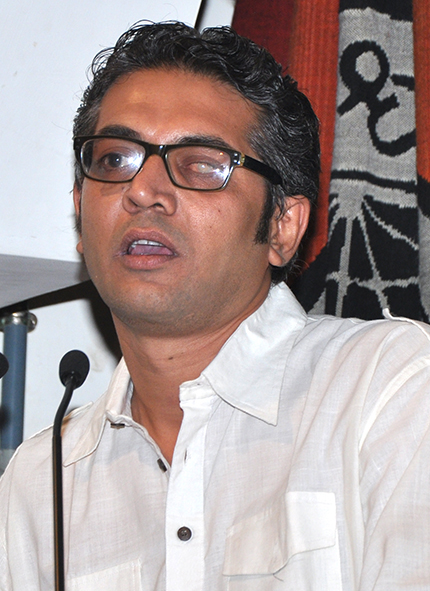
Joshi taught English literature at H. K. Arts College in Ahmedabad from 1995 and left the job in September 2011 to work in theatre full time, having founded Fade-In Theatre the year before. His play Dost Chokkas Ahin Ek Nagar Vastu Hatu, a musical black comedy about the 2002 Gujarat riots, got The Week to name him one of India's fifty rising stars in 2003, and Aathma Taaru Nu Aakash became the first play from Gujarat selected for the Prithvi Theatre Festival in 2005. Welcome Zindagi and 102 Not Out are his best known plays. His poetry collection Greenroomma appeared in 2008. He holds the Chandravadan Chimanlal Mehta Award from 2013, the Yuva Gaurav Puraskar from 2007 and the Takhtasinh Parmar Prize.
In cinema he is credited as a writer on the Hindi film 102 Not Out, adapted from his own play and directed by Umesh Shukla, and he wrote the dialogues and lyrics for Hellaro. That is a small filmography attached to a very large body of work, and the ratio is the point. Joshi writes for a room full of people who have paid to sit in the dark for two hours with no edit button and no second take. Everything he brings to a screenplay was pressure tested on a stage first.
Photo: Gujarat Vishw Kosh Trust, CC BY-SA 4.0, via Wikimedia Commons.
19Dhwani Gautam
Dhwanii M Gautam wrote and directed Romance Complicated in 2016, a romantic comedy that gave Malhar Pandya and Divya Misra their lead debuts. He returned in 2019 with Order Order Out of Order, which he directed and co-wrote with Shyam Khandhedia and Vipul Sharma. He is also known for Hoon Tari Heer, and he works across Gujarati and Hindi rather than staying inside one industry.
He is the most visible writer on this list by a distance, with an audience approaching two hundred thousand on Instagram, which for a screenwriter anywhere in India is unusual. That matters more than it sounds. Regional writers have almost no public identity, so they have no leverage in a fee negotiation and no direct line to an audience. Gautam built one. Whatever else the next generation of Gujarati writers copies from this list, that is the habit worth stealing.
Instagram: @dhwanigautam (verified 2026-07-29).
What the numbers say
Named Gujarati feature writing credits per writer
Bars count Gujarati feature writing credits that can be traced to a named film in an IMDb-sourced credits database of 118 Gujarati films. Shared credits count once for each named writer. Hindi, Marathi, television and streaming work is excluded, which is why Niren Bhatt shows three. Where the database's headline tally disagreed with its own list of titles, the enumerated titles were used, and where a film's own credits contradicted the database, the film won. That is why Vipul Sharma shows three rather than four.
Questions people actually ask
Who is the best Gujarati screenwriter?
By produced volume it is Krishnadev Yagnik, with nine named Gujarati feature writing credits including Chhello Divas, Shu Thayu?, Raado and Vash, which won Best Gujarati Feature Film at the 71st National Film Awards. By critical standing the answer is Abhishek Shah, whose Hellaro won the National Film Award for Best Feature Film at the 66th ceremony, the top prize in Indian cinema that year.
Which Gujarati screenwriter made it big in Bollywood?
Niren Bhatt. He wrote Bey Yaar, Wrong Side Raju and Ventilator in Gujarati, then wrote Bhediya, Munjya and Stree 2 in Hindi, the last of which became one of the highest grossing Hindi films of all time. He is credited as co-creator of the Maddock Supernatural Universe with Amar Kaushik and has two Filmfare nominations, for Best Dialogue at the 65th awards and Best Story at the 68th.
Who wrote Hellaro?
Hellaro was co-written and directed by Abhishek Shah, his debut as a director. Saumya Joshi wrote the dialogues and the lyrics. The film won the National Film Award for Best Feature Film at the 66th National Film Awards and opened the Indian Panorama at the 50th International Film Festival of India.
Which Gujarati writer has won a literary award?
Raam Mori won the Sahitya Akademi's Yuva Puraskar in 2017 for his debut short story collection Mahotu, and he is best known for fiction set in rural Saurashtra with female protagonists. He has since written five Gujarati features including 21mu Tiffin, which is adapted from his own short story, plus Montu Ni Bittu, Mara Pappa Superhero, Kasoombo and Maharani.
How many Gujarati films actually have verified writer credits?
Roughly 104 out of 582 Gujarati films catalogued between 2014 and 2026 have verified writer data, and 98 have both writer and producer credits confirmed. The gap is not carelessness. Several hundred ultra small regional releases never get an IMDb page at all, so their writing credits exist only on the print itself.
Sources and image credits
All photographs are free-licensed files from Wikimedia Commons, reused with the attribution each licence requires. No press agency or studio photographs are hosted on this site. Instagram content is linked or embedded from the official account, never re-hosted.
- gujarati-cinema-credits database, IMDb-sourced writer and producer credits for 118 Gujarati films, 2014 to 2026
- English Wikipedia biographies of Krishnadev Yagnik, Raam Mori, Niren Bhatt, Pan Nalin, Mikhil Musale, Manish Saini, Faisal Hashmi, Saumya Joshi, Dhwani Gautam and Hardik Mehta, retrieved July 2026
- English Wikipedia film articles for Hellaro, Chhello Divas, Shu Thayu?, Vash, Vash Level 2, Wrong Side Raju, Ventilator, Bey Yaar, Chaal Jeevi Laiye!, Ole Aale, Chor Bani Thangaat Kare, Dhh, Vitamin She, Short Circuit, Romance Complicated, Fakt Mahilao Maate, Kasoombo, Maharani, Mara Pappa Superhero, Montu Ni Bittu, Nayika Devi, Order Order Out of Order, Ratanpur, 21mu Tiffin, Gujjubhai the Great, Laalo, Last Film Show, Stree 2, Bhediya, Munjya and Scam 1992, retrieved July 2026
- English Wikipedia ceremony records for the 63rd, 64th, 65th, 66th, 70th and 71st National Film Awards, retrieved July 2026
- Wikimedia Commons imageinfo and globalusage API for every photograph licence, attribution and identity check
- Instagram profile and post data retrieved through the Apify Instagram scraper on 29 July 2026 for handle verification
- Box office figures for Laalo and Chaal Jeevi Laiye! are industry-reported worldwide gross as compiled in the What The Gujarati highest grossing list, not audited returns